Showing posts with label Trans Lives Matter. Show all posts

Wednesday, October 11, 2023

National Coming Out Day

Every year on October 11th, the anniversary of the 1987 March on Washington for Lesbian and Gay Rights, we recognize the diverse range of experiences that LGBTQ folks have when coming out. So whether you are out, find yourself coming out over and over again, or are not out yet, know that you are loved just as you are, you are seen, and you are beautiful. 

Friday, June 30, 2023

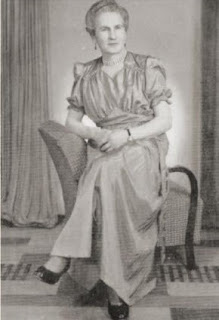
Gay History: Toni Simon

Born Anton, Toni Simon (1887 - 1979) was raised in Thuringia, Germany. Even as a child Simon wore girls’ clothes whenever possible, and was pleased to do housework with her mother. At age 17, Simon volunteered for the cavalry to avoid service in the infantry where his ‘girlish’ gait would be mocked. After completing three years of service, Simon became a machinist in a bicycle factory, worked in breweries and tanneries, went to sea as a stoker and herring fisherman, and even worked as a bridge builder in northern cities such as Kiel, Wilhelmshaven and Bremen. When World War I broke out in August 1914 Simon was running a business selling newspapers and maps, which was taken over by his wife while he was conscripted. After 1918, Simon opened a restaurant in the Ruhr area, and in 1923 opened Café 4711 in Essen's Segerothstraße, which also acted as a “neuer Damenklub” for Essen’s transvestites. Herr and Frau Simon separated in 1927 and their divorce was finalized in 1932. The marriage produced five children.

Simon was arrested several times for illegal beer sales from the secret bottle cellar of Café 4711. In August 1929, Simon was summoned to appear before the Essen district court, and appeared in women's clothes. The judge found this "improper", and imposed an administrative fine of 100 marks. Simon's appearance caused a stir not only in the Ruhr press, but also in the Berlin transvestite scene. Completely impoverished by 1932, Simon had  to close Café 4711. After the Nazi takeover in 1933, Simon’s Transvestitenschein, official permission to wear female clothing, was cancelled. 

After his release from Welzheim police prison/concentration camp in 1939, Simon worked as a tester of high-voltage pylons. In this, and in the applications for reparations, she was referred to as Anton and Herr Simon. Yet, at the same time she was considered as a survivor of the pre-war queer scene in Stuttgart, and worked with the gay group Kameradschaft die runde which met in Stuttgart pubs. She arranged meetings and dances, and ‘Toni Simon’ was mentioned in advertisements in the local press. Her Transvestitenschein had been restored in 1951.

She supplemented her pension in the 1950s by smuggling in queer pornography from Denmark which at that time had a more liberal attitude to such publications.

Toni Simon died age 92.

( ~ Zagria)

Gay History: Sylvia Rivera

A veteran of the 1969 Stonewall Inn uprising, Sylvia Rivera (1951-2002) was a tireless advocate for those silenced and disregarded by larger movements. Throughout her life, she fought against the exclusion of transgender people, especially transgender people of color, from the larger movement for gay rights.

Rivera was born in New York City in 1951 to a father from Puerto Rico and a mother from Venezuela. She was assigned male at birth. Rivera had an incredibly difficult childhood. Her father was absent and her mother died by suicide when Rivera was 3 years old. Raised by her grandmother, Rivera began experimenting with clothing and makeup at a young age. She was beaten for doing so and, after being attacked on a school playground in sixth grade by another student, suspended from school for a week. Rivera ran away from home at age 11 and became a victim of sexual exploitation around 42nd Street.

In 1963, Rivera met Marsha P. Johnson and it changed her life. Johnson, an African American self-identified drag queen and activist, was also battling exclusion in a movement for gay rights that did not embrace her gender expression. Rivera said of Johnson that “she was like a mother to me.” The two were actively involved in the Stonewall Inn uprising on June 28, 1969 when patrons of the Stonewall Inn—a gay bar in Greenwich Village in lower Manhattan—rebuffed a police raid and set a new tone for the gay rights movement. Rivera said in an interview in 2001 that while she did not throw the first Molotov cocktail at the police (a long-enduring myth), she did throw the second. For six nights, the 17-year-old Rivera refused to go home or to sleep, saying “I’m not missing a minute of this—it's the revolution!”

( ~ National Women's History Museum) Read the full article.

Thursday, June 29, 2023

Gay History: Marsha P. Johnson

Marsha P. Johnson (1945-1992), who would cheekily tell people the "P" stood for "pay it no mind", was an outspoken transgender rights activist and is reported to be one of the central figures of the historic Stonewall uprising of 1969. Following the Stonewall uprising, Johnson joined the Gay Liberation Front and was active in the GLF Drag Queen Caucus. On the first anniversary of the Stonewall rebellion, on June 28, 1970, Johnson marched in the first Gay Pride rally, then called the Christopher Street Liberation Day. One of Johnson's most notable direct actions occurred in August 1970, staging a sit-in protest at Weinstein Hall at New York University alongside fellow GLF members after administrators canceled a dance when they found out that it was sponsored by gay organizations. 

During a gay rights rally at New York City Hall in the early '70s, photographed by Diana Davies, a reporter asked Johnson why the group was demonstrating, Johnson shouted into the microphone, "Darling, I want my gay rights now!"

Along with fellow trans activist Sylvia Rivera, Johnson helped form Street Transgender Action Revolutionaries (STAR), a radical political organization that provided housing and other forms of support to homeless queer youth and sex workers in Manhattan. The two of them became a visible presence at gay liberation marches and other radical political actions. She was also a popular figure in New York City's gay and art scene, modeling for Andy Warhol, and performing onstage with the drag performance troupe Hot Peaches from 1972 through the ‘90s. Johnson was also an AIDS activist with AIDS Coalition to Unleash Power (ACT UP).

Johnson's body was found floating in the Hudson River in 1992. Initially and quickly ruled a suicide by the NYPD, controversy and protest followed, eventually leading to a re-opening of the case as a possible homicide.

( ~ Wikipedia)

Thursday, June 8, 2023

Gay History: William Dorsey Swann

William Dorsey Swann (1860 – 1925) was an American LGBTQ activist in a time where leadership in the movement was uncommon. An African-American born into slavery, Swann was the first person in the United States to lead a queer resistance group and the first known person to self-identify as a "queen of drag".

During the 1880s and 1890s, Swann organized a series of drag balls in Washington, D.C. Most of the attendees of Swann's gatherings were men who were formerly enslaved who gathered to dance in their satin and silk dresses. This group was known as the "House of Swann". Swann participated in dances such as the cakewalk, a dance performed by enslaved people in America, mimicking the mannerisms of plantation owners. The cakewalk’s improvisational movements and subtle expressions of communication resemble voguing, the style later popularized in Harlem’s ball scene.

Swann was arrested in police raids numerous times, including the first documented case of an arrest for female impersonation in the United States, on April 12, 1888. This event was Swann's thirtieth birthday celebration. According to The Washington Post, he was "arrayed in a gorgeous dress of cream-colored satin". After the celebration was raided by police, Swann was "bursting with rage", as he stood up to one of the arresting officers and declared "you is no gentleman".

Swann's choice to resist that night rather than to submit passively to his arrest marks one of the earliest-known instances of resistance in the name of gay rights. The arrests made at Swann's parties were published in local newspapers, so townsfolk risked their reputation by attending. However, acts of public shaming like this one are the only reason we now know who Swann was.

In 1896, he was convicted of "keeping a disorderly house", a euphemism for running a brothel, and was sentenced to 10 months in jail. After his sentencing, he requested a pardon from President Grover Cleveland. This request was denied, but Swann was the first American on record who pursued legal and political action to defend the LGBTQ community's right to gather.

(~ Wikipedia)